The smart surface: why liquid applied membranes are winning the roof war — a 2026 financial deep dive
If you manage a commercial property—be it a manufacturing plant, a sprawling retail center, a high-tech data hub, or a critical healthcare facility—you’ve inevitably faced the “Roofing Crossroads.” One path, the well-trodden but costly one, leads to a massive capital expenditure: a full, disruptive tear-off and replacement. The other is less traveled, but increasingly popular, profitable, and environmentally responsible: Liquid Applied Membranes (LAM).
As we move through 2026, the financial argument for LAM is no longer just about “saving a few bucks” today—it’s about establishing a superior, long-term Return on Investment (ROI) and a cyclical maintenance strategy over the next 20 to 30 years. Traditional roofing, while necessary in some cases, often represents a major depreciation event. A high-performance LAM system, conversely, represents a restorative asset.
Here is a detailed breakdown of why choosing a liquid-applied system over a traditional replacement is the smartest fiscal and operational move you can make:
1. Slashing Upfront Costs: The Immediate Capital Advantage
The most immediate and compelling benefit of a Liquid Applied Membrane system is the dramatic difference in the initial price tag. A full roof replacement is a complex, large-scale construction project involving extensive demolition, heavy machinery, large crews, and significant material and logistical costs.
- Traditional Replacement: Typically costs between $10 and $20+ per square foot. This price point is subject to wild fluctuations based on material selection (e.g., TPO, EPDM, PVC, built-up), the complexity of the roof geometry, local labor rates, and the required number of tear-off layers. This is a massive, immediate capital hit.
- Liquid Applied Membrane (LAM): Usually ranges from a highly efficient $3 to $5 per square foot for a high-solids, high performance system (like silicone or polymethyl methacrylate/PMMA). This cost covers professional preparation, primer, flashing reinforcement, and the final monolithic topcoat.
The Financial Impact: For a medium-sized, 50,000-square-foot commercial facility, this is the critical difference between a potential $750,000 to $1,000,000 capital expenditure (replacement)and a manageable $150,000 to $250,000 maintenance expense (LAM). Shifting this spend from a capital expense to a maintenance expense can also offer significant benefits for quarterly financial reporting and budgeting.
2. Elimination of "Tear-Off" and Disposal Fees: A Twofold Saving
When you opt for a full roof replacement, you are not just paying for the new materials; you are paying a premium to legally, safely, and laboriously get rid of the old ones. These “soft costs” have grown exponentially.
- Labor & Time: Tearing off an existing roof is labor-intensive, slow, and unpredictable. Finding and hauling away hundreds of squares of roofing material adds weeks to a project timeline.
- Landfill and Tipping Fees: Disposal costs for commercial roofing debris (which often contains heavy, petroleum-based materials) have skyrocketed across the nation. Regulations are tightening, making disposal more expensive and logistically difficult.
- The LAM Advantage: Zero Waste: Because a high-performance LAM is applied directly over your existing, structurally sound, and dry roof surface, you eliminate these costs entirely. You avoid the costs associated with specialized disposal dumpsters, hauling permits, and tipping fees. Crucially, this helps meet increasingly important Corporate Social Responsibility (CSR) and Environmental, Social, and Governance (ESG) goals by keeping tons of construction waste out of local landfills, providing a verifiable metric for sustainability reporting.
When you opt for a full roof replacement, you are not just paying for the new materials; you are paying a premium to legally, safely, and laboriously get rid of the old ones. These “soft costs” have grown exponentially.
- Labor & Time: Tearing off an existing roof is labor-intensive, slow, and unpredictable. Finding and hauling away hundreds of squares of roofing material adds weeks to a project timeline.
- Landfill and Tipping Fees: Disposal costs for commercial roofing debris (which often contains heavy, petroleum-based materials) have skyrocketed across the nation. Regulations are tightening, making disposal more expensive and logistically difficult.
- The LAM Advantage: Zero Waste: Because a high-performance LAM is applied directly over your existing, structurally sound, and dry roof surface, you eliminate these costs entirely. You avoid the costs associated with specialized disposal dumpsters, hauling permits, and tipping fees. Crucially, this helps meet increasingly important Corporate Social Responsibility (CSR) and Environmental, Social, and Governance (ESG) goals by keeping tons of construction waste out of local landfills, providing a verifiable metric for sustainability reporting.
3. Business Continuity and Operational Savings: The "Hidden" ROI
A full roof replacement is a major logistical headache that often translates to a direct loss of revenue.
- Downtime and Disruption: A traditional replacement is loud, messy, and uses heavy equipment (cranes, dumpsters, machinery) that often block entrances, staging areas, and parking lots. For high-traffic businesses—hospitals, data centers, manufacturing lines, or busy retail centers—downtime and disruption are a direct loss of revenue and goodwill.
- Safety and Air Quality: Demolition can generate dust and odors that necessitate vacating parts of the building, especially in sensitive environments.
- Liquid Application: Low Impact: LAM is a “low impact” solution. The application process is quiet, involves smaller crews and equipment, and is far less disruptive. There are no cranes blocking shipping docks, no heavy demolition noise, and significantly fewer, less-invasive odors. Most businesses can remain fully operational throughout the entire process, ensuring your revenue stream remains uninterrupted and allowingpersonnel to work safely and comfortably.
4. Thermodynamic Savings: The "Cool Roof" Effect
The long-term operational savings associated with energy efficiency are one of the most powerful financial arguments for LAM.
- Reflectivity: Most high-quality liquid membranes, particularly bright white silicone and high-performance acrylics, are highly reflective “Cool Roof” systems. While a dark, traditional roof (like EPDM or modified bitumen) absorbs up to 90% of solar heat, a white LAM reflects up to 85-90% of UV rays and solar energy (a measurement known as Solar Reflectance Index or SRI).
- Temperature Differential: By rejecting solar heat, the roof surface temperature can be lowered by as much as 50°F to 80°F compared to a dark roof.
- HVAC Efficiency and Lowered Peak Demand: This massive reduction in heat transfer means the building’s top layer of insulation remains cooler, and your rooftop cooling units (RTUs) do not have to work nearly as hard or run as frequently. Building owners in hot and mixed climates often see a verifiable 10-20% reduction in monthly cooling costs immediately following application. This also reduces the strain on HVAC equipment, extending the life of those costly systems.
5. The "Infinity" Roof Cycle: Moving from Liability to Perpetual Asset
One of the most overlooked, yet transformative, financial benefits of LAM is its renewability and cyclical lifespan. Traditional roofs have a single, terminal lifespan; once they fail (typically 15-20 years), they must be replaced at full cost.
- Renewability: A professionally installed, high-quality liquid system (with proper maintenance) can last 10–20 years, depending on the millage and chemistry.
- The Re-Coat Strategy: At the end of that warranty period, you do not tear it off. You simply perform a fractionally priced “re-coat”. This involves a thorough cleaning and the application of a single, new layer of membrane. This renews the system, restoring the original warranty and high reflectivity at a fraction of the cost of the first application.
- Financial Leverage: This strategy creates an “Infinity” roof lifecycle where you only pay full replacement costs once (if ever), effectively transforming your roof from a depreciating, ticking financial time bomb into a permanent, renewable asset.
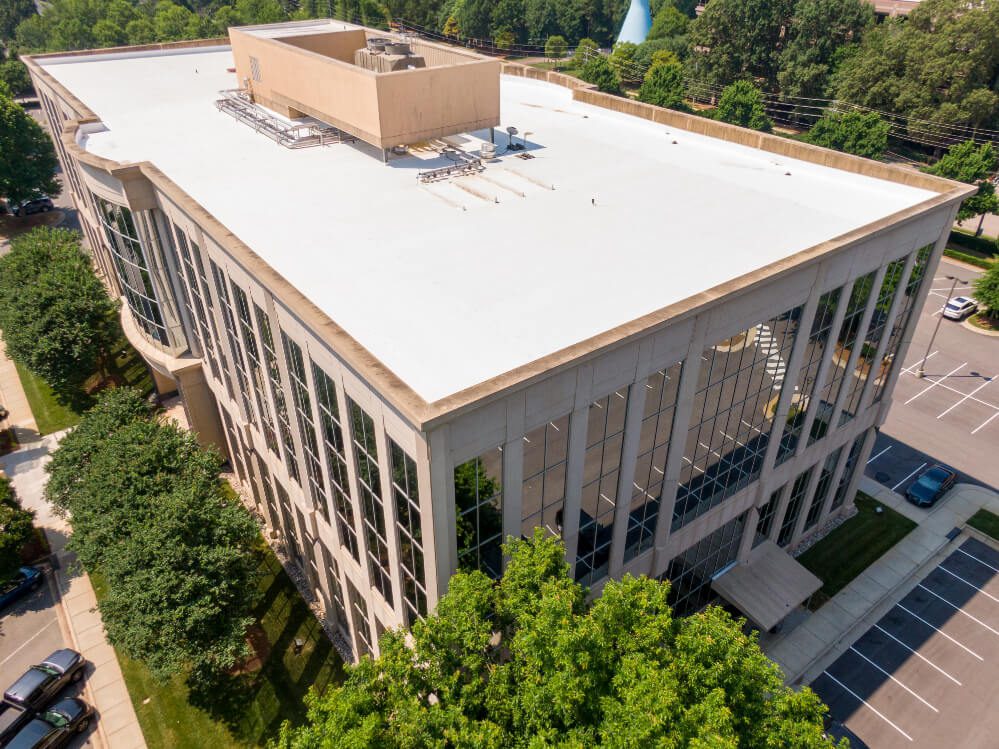
Is Your Roof a Candidate?
It is critical to understand that LAM is a restoration strategy, not a miracle cure for a collapsed or compromised structure. To qualify for these significant savings, a professional inspection is required to confirm:
- Dry Insulation: The underlying insulation must be predominantly dry. Widespread moisture saturation (typically over 25% of the roof area) means the roof must be partially or fully replaced.
- Structural Soundness: The roof deck and system must be structurally sound and free from major defects.
- Basic Integrity: While LAM is excellent at sealing minor leaks, cracks, and seams, the existing roof must be largely intact and adhere well to the deck.
The Verdict
While a full, disruptive replacement might be necessary if your roof has suffered catastrophic structural failure or widespread moisture saturation, the reality is that most commercial roofs are replaced 5 to 10 years earlier than they need to be due to simple surface wear and minor leaks. By opting for a liquid-applied membrane, you aren’t just “kicking the can down the road” —you are choosing a more financially responsible, sustainable, energy-efficient, and operationally sound way to protect and perpetually renew your most valuable asset.